OneLogin is an established Identity and Access Management (IAM) platform that exists within a highly competitive and heavily funded sector.
Modern digital businesses operate in highly decentralized spaces - where the traditional network boundary no longer exists. Because of this, digital identity is now the most important control center for business cybersecurity.
This is why we'll cover the exact pricing, pros, and cons in this OneLogin review. We’ll also address its historical security posture and look at its systemic technical limits.
What Is OneLogin?
OneLogin is a broad identity suite. It is built to systematically remove the operational delays and severe security vulnerabilities associated with separated logins.
One Identity bought the platform in October 2021. The platform acts as a key system part. This part dictates a company's security posture, operational productivity, and regulatory compliance.
This connects modern web access with deep, enterprise-grade governance backends. This positions the platform to supply security-focused functions. These functions support advanced risk-based governance and Identity Threat Detection and Response (ITDR).
What is OneLogin used for?
Common business use cases for OneLogin include:
- Business Single Sign-On (SSO): This fundamentally lessens password reuse. It does this by centralizing logins through a single screen. This makes sure users log in once. They then gain authorized access to their entire digital workspace.
- Automated User Account Creation: This uses the System for Cross-domain Identity Management (SCIM) protocol. OneLogin automatically creates, modifies, and suspends user accounts across connected applications. It bases these actions on primary Human Resources (HR) changes.
- Risk-Based Authentication: This moves beyond simple yes or no login rules. It uses machine learning to dynamically check the contextual risk of every single login attempt. The system aggressively challenges high-risk behavior. At the same time, it allows low-risk routine logins.
- Customer Identity and Access Management (CIAM): This gives secure, smooth access for external users. These users include retail consumers or B2B partners. It lets developers build advanced login steps into custom applications via APIs.
- Hybrid Directory Synchronization: This helps companies undergoing phased digital updates. They can connect existing company directories. It smoothly synchronizes older on-premises Microsoft Active Directory (AD) systems with modern cloud spaces.
- Desktop Endpoint Access: This connects hardware access with cloud application permission. It does this by giving native Windows and macOS desktop SSO functions. This secures the broader hardware fleet.
Key Features of OneLogin
The most distinct architectural features of OneLogin include:
- SmartFactor Authentication: The proprietary Vigilance AI threat engine powers this feature. It analyzes telemetric data points. These points include geographic location, IP address reputation, and historical behavioral patterns. It uses this data to generate a real-time risk score.
- Vast Connector Ecosystem: OneLogin has a catalog of over 6,000 pre-built connectors. These natively connect with major business applications. They also connect with specialized business systems. They use SAML and OpenID Connect (OIDC) protocols.
- Identity Lifecycle Management: This process effectively removes manual coordination between IT, HR, and Finance departments. It instantaneously revokes access upon termination. This prevents dormant account breaches.
- Flexible Entitlement Mappings: An employee is onboarded. Their specific departmental attributes automatically trigger the setup of necessary software licenses. This creates admin approval workflows. It also creates application-specific rules.
- Native Desktop SSO: Competitors rely heavily on secondary verification agents. OneLogin operates differently. It permits users to log into their corporate workstations. They subsequently gain token-based access to their cloud applications. They do this without secondary credential inputs.
- CIAM Customization Tools: The platform supports multiple application-level brands and custom login pages. It supports custom email and SMS authentication messages. It also supports dynamic social login connections for massive external portals.
OneLogin Pros and Cons
Most serious reviews of OneLogin highlight its compelling economic return on investment. They also point out its intuitive administrative functions. However, severe operational difficulties and historical stability issues persist.
OneLogin Pros
- Profoundly lowers employee password fatigue. It does this by creating a single, highly intuitive portal interface. This effectively stops dangerous credential write-downs. It also stops weak password reuse.
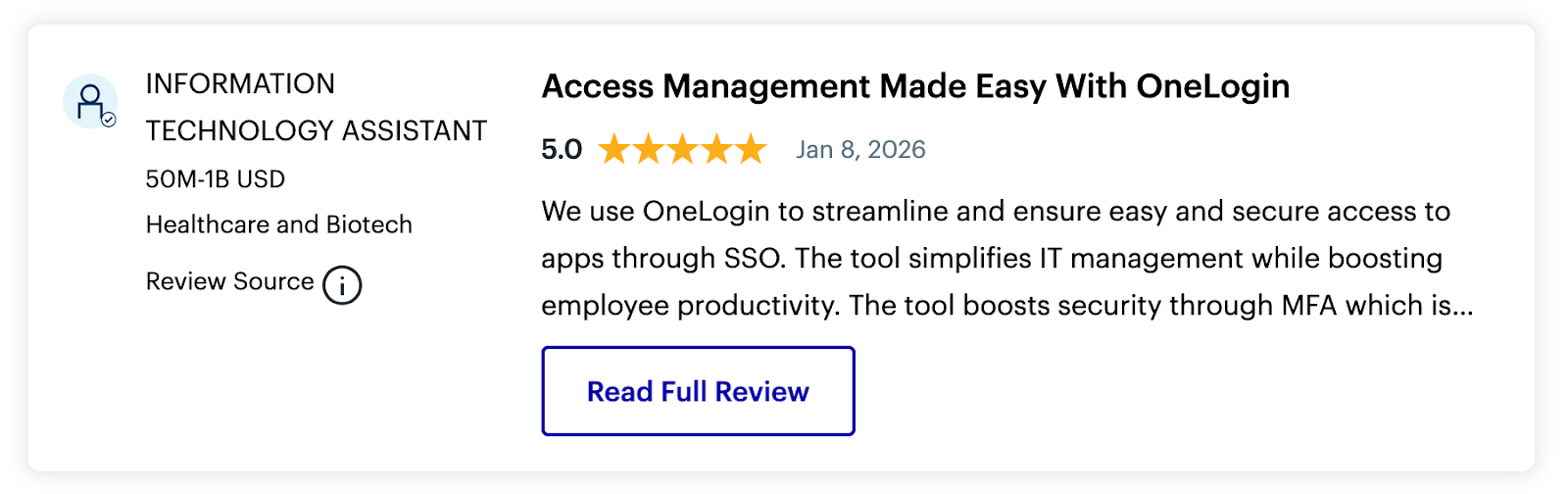
- Delivers great time-to-value. It allows companies to deploy production-ready SSO for thousands of global users. This takes a fraction of the time required by top-tier competitors.
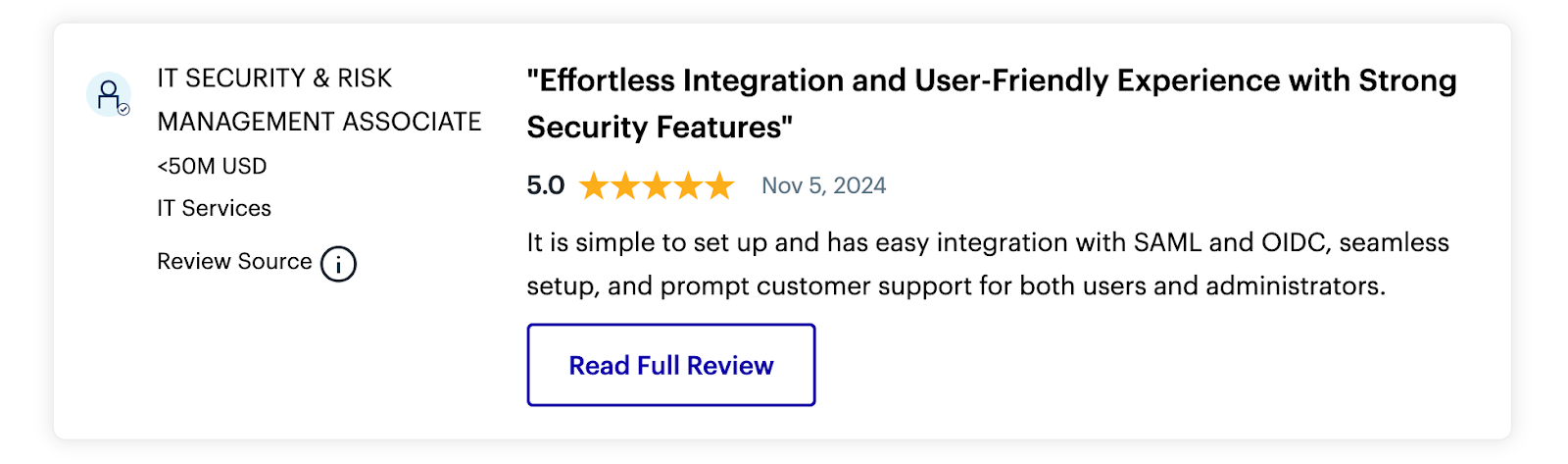
- Maintains strict regulatory compliance frameworks. These include HIPAA and PCI-DSS. It utilizes SmartFactor Authentication to significantly boost safety parameters for vulnerable remote workforces.
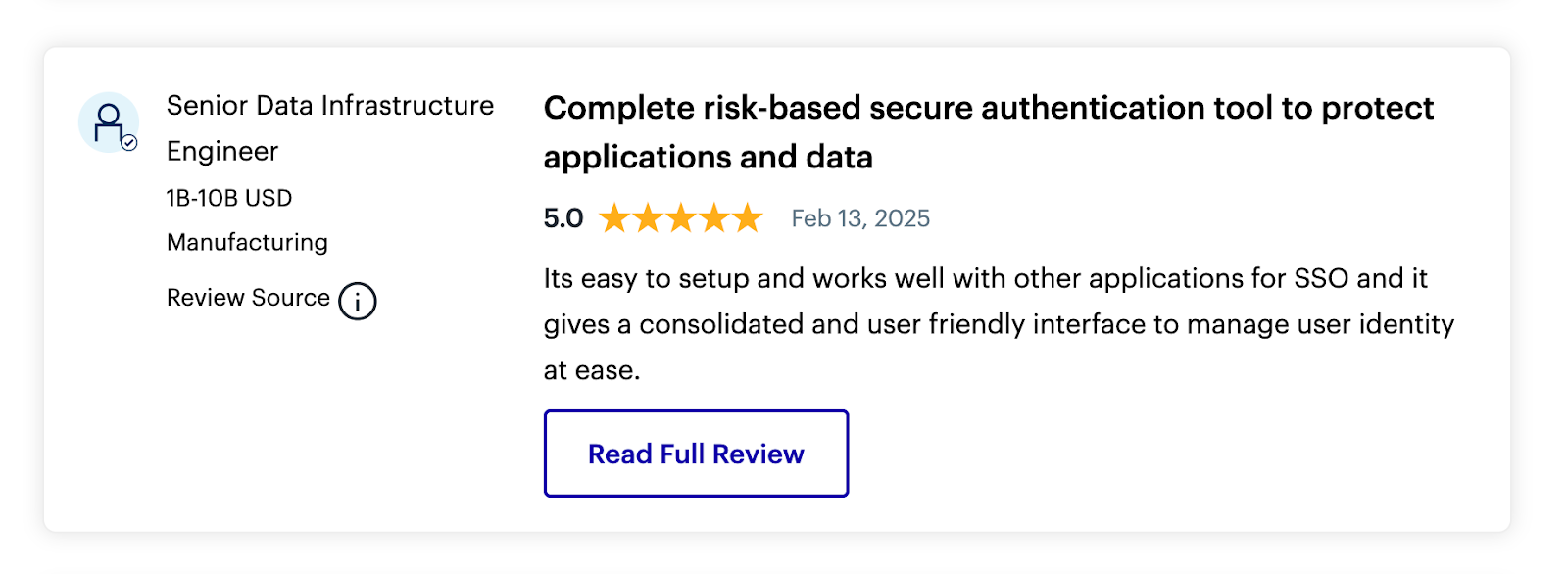
- Yields highly measurable drops in helpdesk support ticket volumes. It does this by allowing end-users to autonomously resolve minor credential issues. They use strong self-service password resets.
- Extends continuous security directly to the endpoint layer. This creates a unified security posture. This posture goes from physical Windows or macOS machines directly to the SaaS application layer.
OneLogin Cons
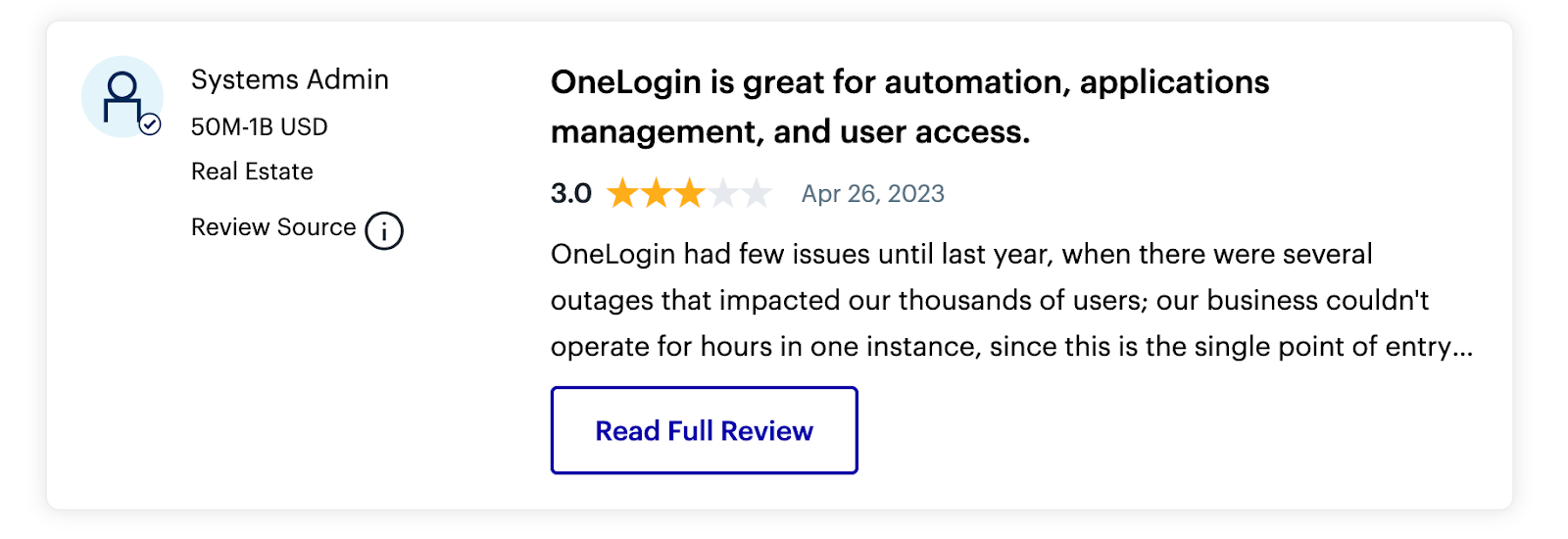
- Occasional connectivity outages and service interruptions happen. These lock entire workforces out of necessary business tools for hours. This exposes the massive systemic risk of centralizing identity into a single point of failure.
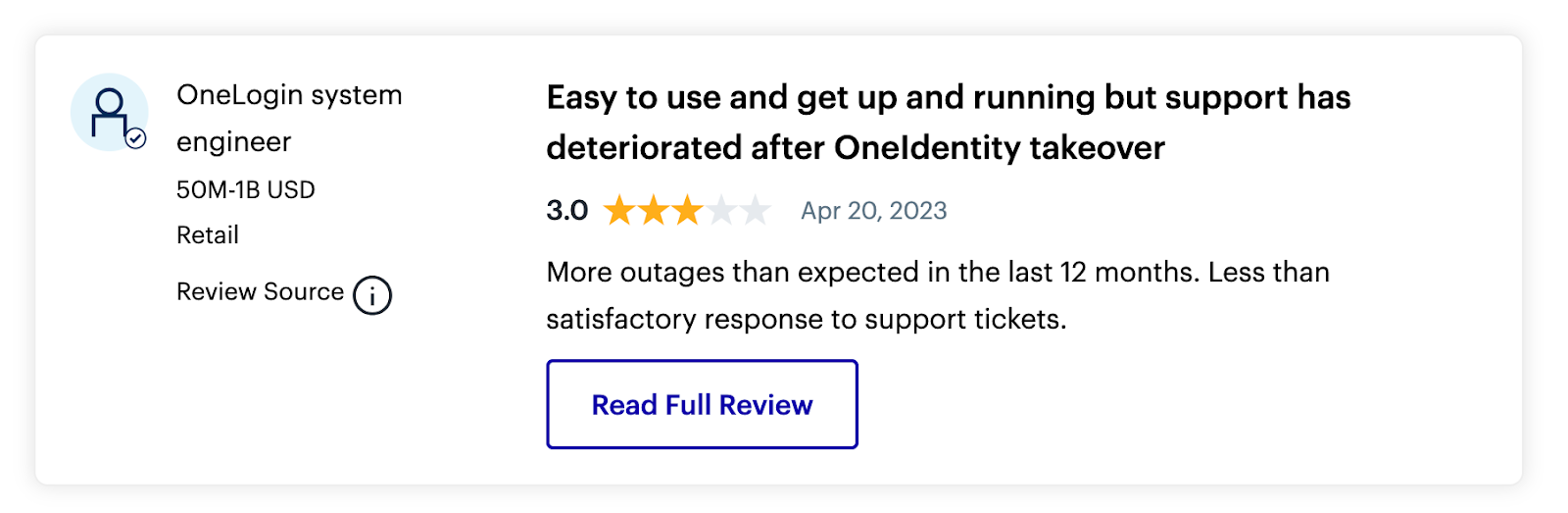
- Customer support responsiveness has noticeably declined following the One Identity acquisition. Users make distinct complaints. These complaints regard poor or unresponsive off-hour technical escalation.
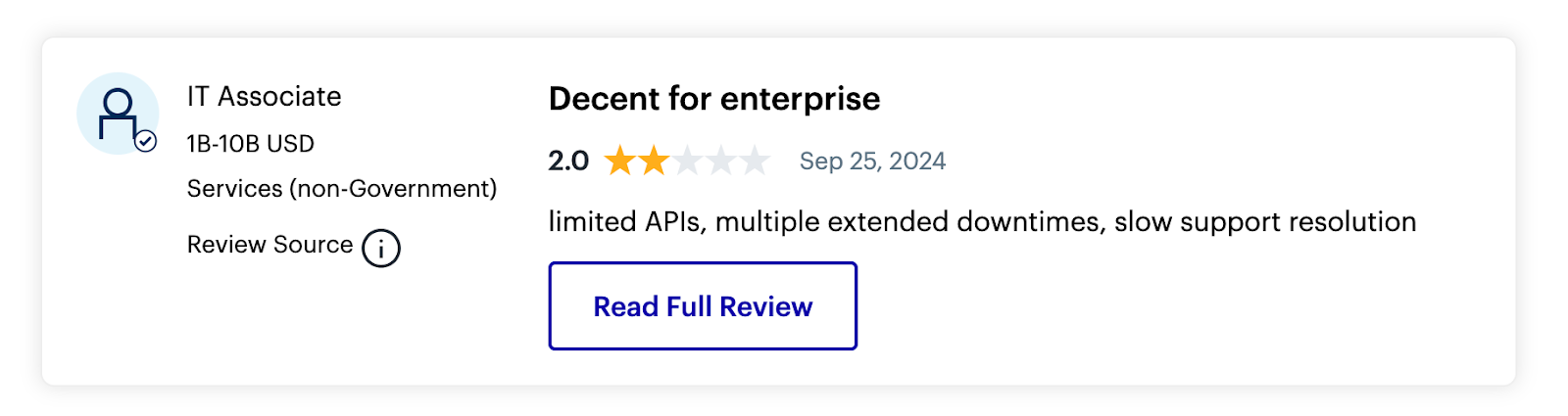
- Advanced engineering teams face restrictive API limitations. These limits severely hinder their ability to fully automate specific administrative tasks. They also make it hard to weave OneLogin smoothly into custom company scripts.
- The mobile application suite suffers from significant performance drops. This causes cumbersome VPN pairing processes. It also causes slow load times and frustrating, unexplained forced re-authentications.
- The platform has a severely damaging historical security posture. A 2017 AWS system compromise highlights this. Attackers accessed central database tables and decrypted customer keys. This required sweeping structural repairs.
OneLogin Pricing
OneLogin stands out in a standard market. It does this through a highly modular, transparent, and competitive pricing layout.
It frequently avoids mandatory minimum contract commitments unlike major competitors. For workforce identity, it utilizes bundled per-user, per-month tiers. These yield significant cost savings compared to purchasing features individually.
The detailed bundles are as follows:
OneLogin's CIAM module operates differently. It uses a Monthly Active User (MAU) metric rather than a strict per-seat license. Unpredictable billing spikes can happen during traffic surges. OneLogin calculates the average MAU over the course of the entire subscription year to prevent this. This delivers a predictable, fixed monthly rate for external-facing portals.
OneLogin Alternatives
The Identity and Access Management market is highly consolidated. Evaluating OneLogin requires a direct comparison. For OneLogin alternatives, we based our choices based on scalability in overheads, ease of implementation, versatile SSO and cross-platform usability. We’ve listed the main market alternatives below:
- Infisign AI is an AI-powered IAM tool with a decentralized architecture. It prioritizes fast deployment and passwordless security. This OneLogin alternative focuses on automation and AI-guided lifecycle management. Infisign thrives where legacy systems struggle. It does this by delivering deep, multi-platform governance across cloud and on-premise assets.
- Okta: This is the main market leader in pure-play cloud identity. It boasts an unmatched connection ecosystem of over 7,000 connectors. It also has massive-scale CIAM via its Auth0 acquisition. However, its pricing scales quickly and aggressively. This happens as advanced features become mandatory.
- Microsoft Entra ID (Formerly Azure AD): This is deeply embedded in the Microsoft 365 cloud ecosystem. Entra ID gives unparalleled cost savings for companies already holding E3/E5 licenses. However, many companies heavily prefer OneLogin. They demand vendor-neutrality. This prevents ecosystem lock-in across multi-cloud environments.
- Ping Identity: This is designed specifically for massive global enterprises. These enterprises have highly regulated legacy systems. Ping presents an unmatched protocol federation. However, its deployments are notoriously complex. They require heavy professional services. OneLogin yields a far superior time-to-value for mid-market setup.
- JumpCloud: This heavily targets the Small and Midsize Business (SMB) sector. It acts as a holistic replacement for Active Directory. It bundles MDM and LDAP into a single tool. OneLogin is far more specialized. It possesses deeper lifecycle management functions for mature enterprise portfolios.
FAQs on OneLogin
How did the One Identity acquisition impact OneLogin?
One Identity acquired the company in October 2021. This attached OneLogin's modern cloud-native Access Management frontend onto One Identity's legacy, enterprise-grade Identity Governance and Administration (IGA) backend.transition severely slowed product innovation speed. It also disrupted customer support responsiveness.
How does OneLogin price its CIAM platform compared to its workforce identity?
Workforce identity relies on a predictable per-user, per-month bundled subscription. Customer Identity and Access Management (CIAM) uses a different model. It utilizes a Monthly Active User (MAU) metric. OneLogin bills based on the average MAU calculated over the subscription year.
Can OneLogin handle the security demands of autonomous AI agents?
The fast growth of autonomous AI agents within networks represents a highly dangerous new frontier. OneLogin is increasingly expanding its SmartFactor telemetric analysis. This moves from standard human behavioral patterns to algorithmic and machine request patterns.
What is OneLogin's planned answer to Identity Threat Detection and Response (ITDR)?
OneLogin has a deep connection with One Identity Manager 10.0. Through this, OneLogin is transitioning away from static compliance checklists. The platform is designed to act as an active audit trail.
Is OneLogin more cost-effective than Okta?
Yes. Companies routinely select OneLogin. It delivers approximately 85 percent of Okta's main functionality. These functions include SSO, MFA, and automated lifecycle provisioning. It does this at a significantly lower and more predictable total cost of ownership.